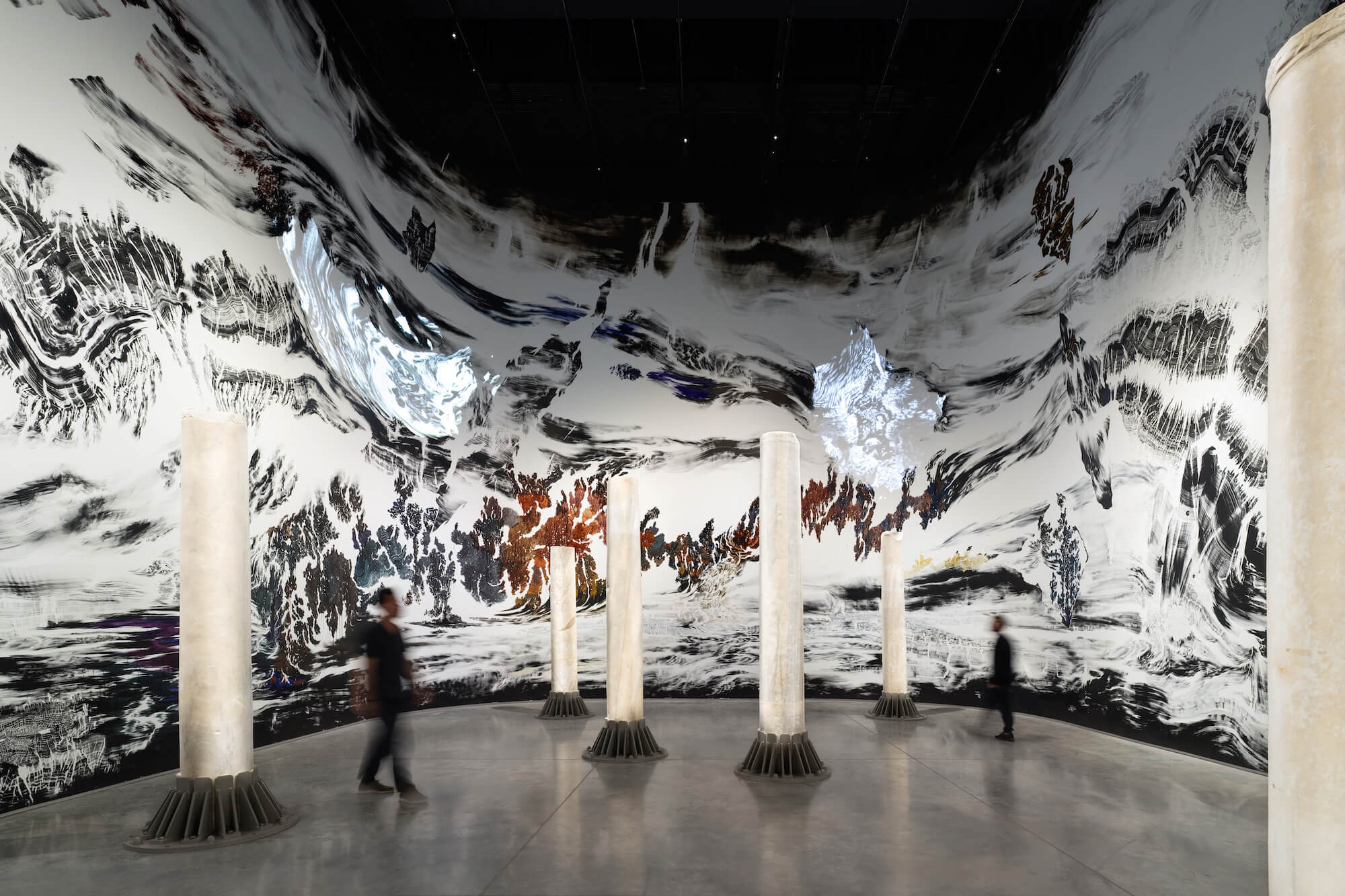
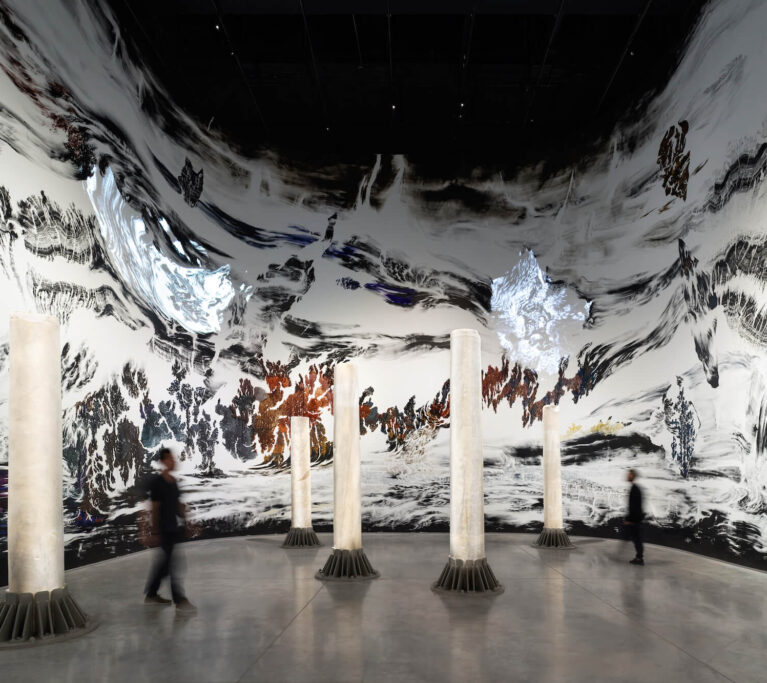
If art is about turning feeling into meaning, then the greater its effect, the more power it has to transform our ideas. Standing alone inside artist Abdelkader Benchamma’s audiovisual work Between Each Sky at the 2025 Islamic Arts Biennale in Jeddah, Saudi Arabia, this spring was the perfect evocation of this. A vast curved fresco depicting sweeping skies in ink and charcoal encircled seven ancient columns from Mecca. Across the walls, the skies were animated with projected films: clouds shifted, lights flickered, and a storm gathered to create a brooding atmosphere. The art installation also reflected a new cultural movement that embraces technology in art, giving artists new tools and viewers new experiences.

It was a taste of the larger-scale immersive exhibitions being pioneered in Saudi Arabia and the UAE, such as those by teamLab, the digital collective that harnesses video, projection and interactive design, transforming it into a popular phenomenon from Tokyo (their original home) to Singapore, and more recently, Jeddah and Abu Dhabi. To step inside one of their installations is to feel as if you’ve entered a computer, not unlike the 1980s film Tron. Shapes shift, floors seem fluid, and rooms brim with the kind of heightened visual stimulation that excites children and sparks philosophical reflection in adults.

Teamlab Phenomena, an immersive artwork experience museum, in Saadiyat Cultural District in Abu Dhabi. Photo: Giuseppe Cacace / AFP

Its first Middle Eastern branch, teamLab Borderless Jeddah, opened in June 2024 and features 80 interconnected installations. In April 2025, the group landed in the UAE, in Abu Dhabi’s Saadiyat Cultural District, with teamLab Phenomena, encompassing 700 Epson projectors spread over 17,000sqm. Entire worlds come to life here: a vortex in an ocean, the movement of the wind, a flock of birds, a flutter of butterflies.

This kind of immersive art relies on intricate programming, with teamLab experts coding everything on Macs, much like a group of developers building a new app. Their goal is to blend art and science, using technology to make the artworks respond and transform. Innovations include touchpoints that let visitors influence the direction of waves on a wall, or sensors that trigger spiralling shapes when someone moves nearby. The system can even ‘learn’ from visitor interactions, allowing artworks to grow and evolve like plants or rippling water.

Slavs & Tatars 3, Islamic Arts Biennale 2025. Photo: Marco Cappelletti, courtesy of The Diriyah Biennale Foundation

Elsewhere in the Saadiyat Cultural District, the Louvre Abu Dhabi has embraced the new educational potential of virtual reality (VR). Its Quantum Dome Experience, launched in July 2025, allows visitors to step into digitally reconstructed worlds from Imperial Rome to Mughal India using a full-body tracking system, virtually ‘picking up’ and examining objects along the way. The museum has also gone further than its Paris namesake by harnessing artificial intelligence (AI) to auto-translate exhibition text, generate image mosaics, simplify the discovery of collection objects via the official app, and even evaluate proposals for new artworks submitted by artists.

Riyadh’s Noor Festival, meanwhile, has showcased the power of AI and immersive art through large-scale light installations spread across the Saudi capital. In 2024, Krista Kim’s work Heart Space transformed collected heartbeats into visual symphonies. Also on show was Random International’s Alone Together, which used a custom tracking system to spotlight selected passers-by.

Arcangelo Sassolino 5, Islamic Arts Biennale 2025. Photo: Marco Cappelletti, courtesy of the Diriyah Biennale Foundation

Reflecting a European trend of moving art outside city centres, as seen with the V&A Dundee or the Centre Pompidou-Metz, the UNESCO World Heritage Site of Diriyah, on the outskirts of Riyadh, has become one of the leading cultural destinations in the Kingdom. The town encompasses the historic Al-Turaif royal district, once the seat of the first Saudi state, as well as a former industrial area that has been repurposed for culture. Several art institutions have made their home here, including the Diriyah Contemporary Art Biennale. The former industrial sheds of the JAX District now host new galleries and creative spaces.

Diriyah Art Futures (DAF) is the first MENA institution dedicated to digital arts, combining VR, projection mapping, sensor-based installations and AI-generated works. Its inaugural exhibition Art Must Be Artificial: Perspectives of AI in the Visual Arts, curated by Jérôme Neutres, drew on Guy Ullens’ prestigious digital art collection and featured works by Vera Molnár alongside Saudi artists Muhannad Shono, Lulwah Al-Homoud and Nasser Alshemimry. Pixera servers, LG display screens and Epson 20k projectors are used for exhibitions here, with Creative Technology Group integrating the technical elements.

Hayat Osamah 3, Islamic Arts Biennale 2025. Photo: Marco Cappelletti, courtesy of The Diriyah Biennale Foundation

What’s clear is the way technology has not only changed society but also the art that comments on it. Together, these cultural projects demonstrate the dynamism of Saudi Arabia and the UAE’s art-and-tech scenes. Like Europe, they are rooted in tradition – albeit a different kind – yet they are also fecund zones where innovation can flourish, with budgets that allow lavish technology and high-end presentation to take centre stage.

Are we ready to feel the same awe towards an artwork made by a machine? Time will tell. Philosophy will question. But the world, and art, is changing. Technology is part of culture – and it is changing culture, one pixel at a time.