In 1982, already renowned in Japan but still relatively unknown in the West, Rei Kawakubo, the designer behind Comme des Garçons, debuted a Paris collection that would send such shockwaves through the fashion world that it was dubbed by the Parisian press as “Hiroshima’s revenge”. Made up in war paint and marching to the ominous beat of a drum, Kawakubo’s army of models showcased a series of all-black, structural garments that heralded a new dawn of ragged luxury; some pieces had been nearly eaten apart by vast holes. Perhaps aware of how explosive – and divisive – it would be, Kawakubo had called her collection, simply, Destroy.
The previous decade had seen the steady rise of punk in the UK and the US. A hugely influential subculture spanning music, art, fashion and attitude, it is not an exaggeration to trace punk’s London headquarters to one tiny boutique at 430 King’s Road, West London, run by the late designer Vivienne Westwood and her then-partner Malcolm McLaren. Opening as Let it Rock in 1971 and cycling through various iterations – its most infamous being Sex, from 1974 – it was here that Westwood first began selling her clothes, pieces which had already been made covetable by The Sex Pistols, and which were characterised by provocation and a DIY aesthetic. In a 2014 New Yorker profile on Kawakubo, McLaren remembers a visit by the then-unknown Japanese designer to the Sex shop in the mid-1970s, describing her as an “excellent” customer.

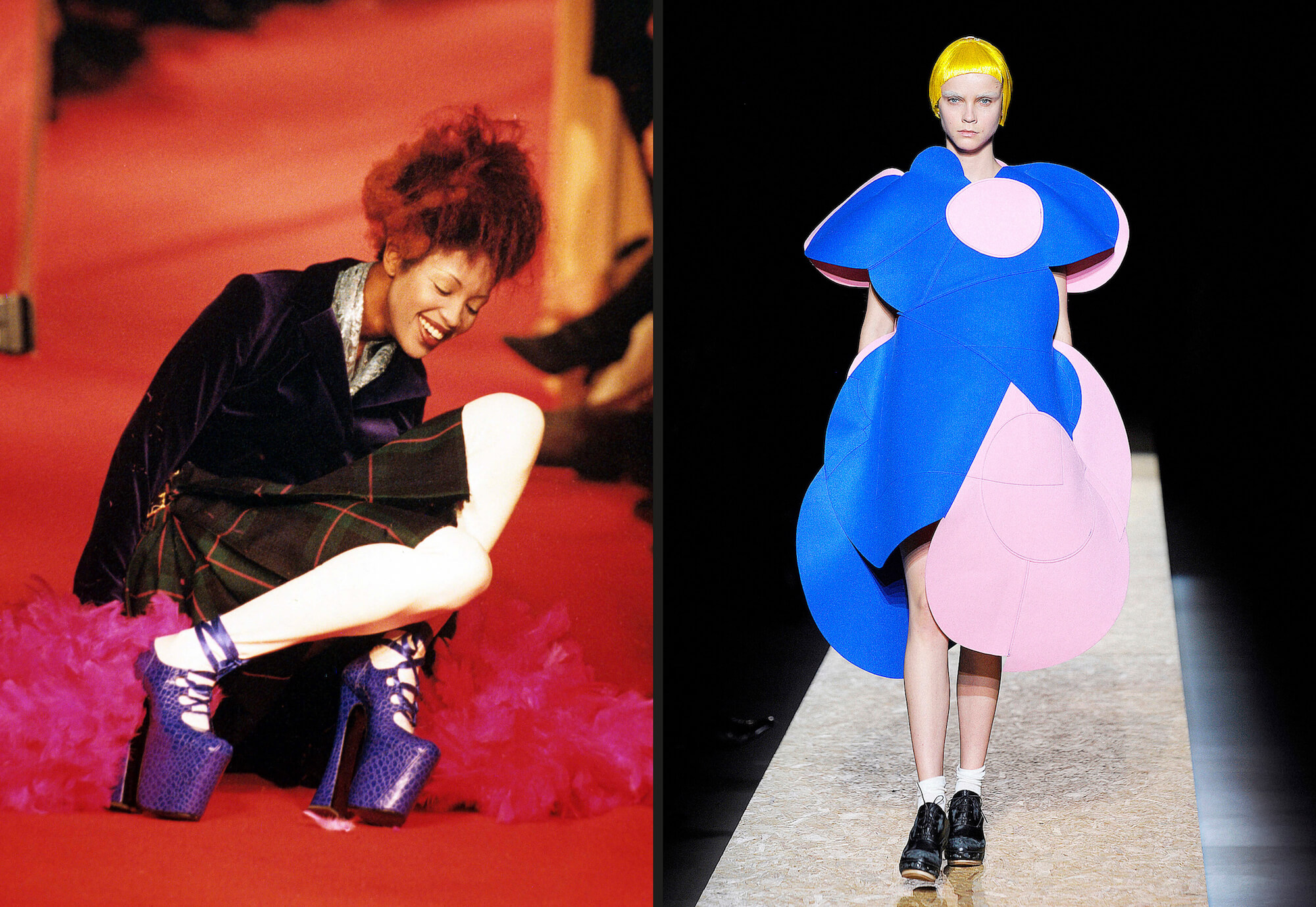
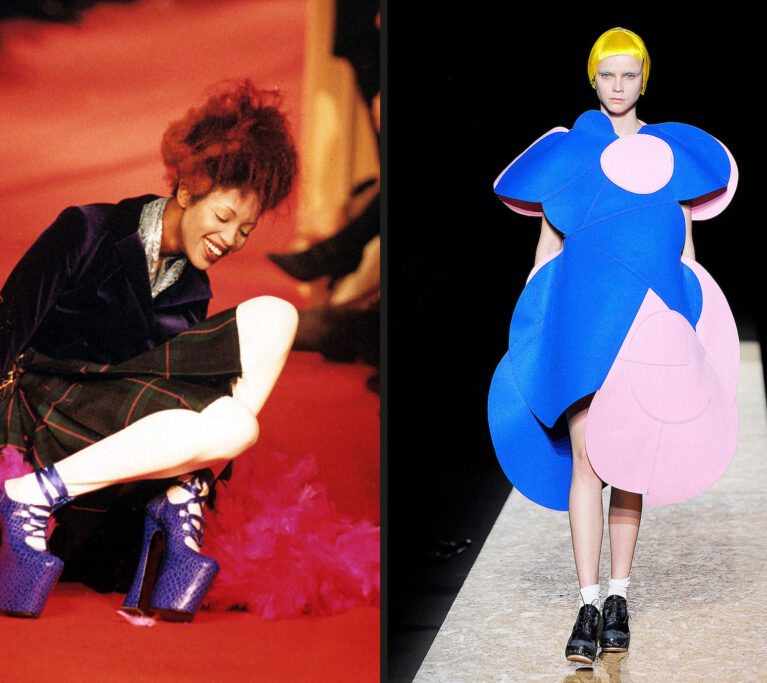
Vivienne Westwood, London (fashion house), Vivienne Westwood (designer) Look 49, from the Anglomania collection, autumn–winter 1993–94. Le Cercle Républicain, Paris, March 1993. Photo © firstVIEW. Model: Kate Moss
Two seemingly distinct titans of fashion, but look more closely at the work of Kawakubo and Westwood and echoes start to abound. Now, for the first time, their overlap and parallels are set to be explored in Westwood/Kawakubo, a blockbuster exhibition by Melbourne’s National Gallery of Victoria (NGV) that will run from December 2025 through April 2026.
Born one year apart at the outset of the 1940s, both women would go on to make decades of radical, disruptive work, work that would be credited time and time again with overhauling fashion entirely. Their twin revolutionary spirits – Westwood is said to have once told Kawakubo that she considered her a “punk at heart” – are partly due to the contexts each designer emerged in. Both war babies, albeit in different countries and cultures, Westwood and Kawakubo grew up in a time of exceptional social and political upheaval: Westwood in a working-class family that moved to London when she was a teenager, and Kawakubo as the child of divorced parents, which at that time was extraordinarily unusual in Japan.
Neither designer received any formal training in fashion, and both had other lives before they began making clothes. Westwood worked in a factory before becoming a primary school teacher; her earliest entry into fashion was making jewellery to sell on a stall in Portobello Market. Kawakubo studied art and literature at Keio University before landing a job in advertising; it was when she started freelancing as a stylist that she began making clothes.
Comme des Garçons, Tokyo (fashion house), Rei Kawakubo (designer) Look 1, from the Blue Witch collection, spring–summer. Paris, 3 October 2015. Image © Comme des Garçons. Model: Maja Brodin

Perhaps due to their formative experiences of work, their relative later beginnings, and because theirs was the first era of the ‘emancipated woman’, both designers always had an intricate understanding of commerce. Westwood used the King’s Road boutique to launch her brand to the world, while Kawakubo had hundreds of Comme des Garçons stores throughout Japan by the early 80s, as well as founding the global concept store Dover Street Market in the early 2000s. She once told The New Yorker, “I’m not an artist, I’m a businesswoman… Well, maybe an artist/businesswoman.” To Interview Magazine, a decade before she died, Westwood described punk as, “A marketing opportunity.”
All of this says little of their actual designs, although both are and were such singular, visionary designers that they resist easy comparison or even categorisation. Throughout her life, Westwood would balance her early provocation with a rigorous study of fashion history. Her research-based approach would define the structured silhouettes of her 1981 Pirate collection – her first catwalk show, which saw models clad in captain’s hats and nods to 18th- and 19th-century dress – and Anglomania, in 1993 – which combined French couture-inspired technique with English tailoring in a series of tartan garments. Kawakubo’s practice, meanwhile, was one of constantly engineering and re-engineering the very form of garments, most memorably in her 1997 Dress Meets Body, Body Meets Dress collection, otherwise known as ‘lumps and bumps’.
Still, there are parallels to be drawn. “Both designers’ work acts as a clarion call to reconsider the body,” says news editor of American Vogue Anna Cafolla. “I think of Comme’s fall–winter 2017 show, ‘the future of the silhouette’, which confronted what’s considered the ‘feminine’ shape with sculptural, body-warping looks topped with steel wool wigs. With Westwood, I think of the nippled T-shirt and that bunching of fabric that’s so playful and sensual, exulting rather than enshrouding nakedness, and of course, her total reinvention of the corset from a sheathed instrument of patriarchy to underwearas-outwear-as-feminist-sexy-design.”

Vivienne Westwood, London (fashion house), Vivienne Westwood (designer) Look 48, from the Les Femmes ne Connaissent pas toute leur Coquetterie collection, spring–summer 1996. Le Grand Hôtel, Paris, October 1995. Photo © PL Gould / IMAGES via Getty Images. Model: Linda Evangelista
Despite both Westwood and Kawakubo being transgressive designers, it speaks to their innate understanding of style, character and people that their work has an enduring, surprisingly broad appeal. In Westwood’s case, her signature corset dresses in particular continue to be a red carpet staple, and while she might have dressed the first generation of punks, today her garments are as likely to be seen on a bride. The character Carrie Bradshaw famously donned a Westwood dress to be jilted at the altar by Big in the 2008 Sex and the City film. Meanwhile, Kawakubo’s avant-garde aesthetic is so formative that in 2017 she became only the second living designer to have an exhibition at the Metropolitan Museum of Art’s Costume Institute, with celebrities paying homage to her with bold, idiosyncratic looks for the 2017 Met Gala.
True originality tends to mean a lasting influence as well as still being widely worn, and both designers remain revelatory and inspirational to a new generation of creatives. Marie Lueder, of the London-based brand Lueder, studied under one of Westwood’s star pupils and even met Westwood as a student herself. Reflecting on the value of bringing these names together for the NGV exhibition, she says: “With Kawakubo, her work is more like armour; there was more focus on the craft. Westwood wanted to make every head turn when she was young, and cars crash when she crossed the street. I think it’s good to bring them together in the same exhibition, because perhaps that’s what their work is about: A confident woman who is a boss, and powerful.”