
















Automotive is a global business; cars are generally the work of ingenious engineers and creative free-wheelers from across the spectrum. You hear a lot about design ‘contamination’, but perhaps ‘diversity’ is more accurate. Ignore the overwrought media headlines: drawing on a disparate bunch of influences and nationalities can surely only be a good thing, right?
Yet we’re all drawn to certain experiences, particularly in the luxury space, because of regional specificities. You notice couture and parfumeries in Paris. The furniture in Stockholm (and Helsinki) airport is visibly superior to Salt Lake City’s – or London Stansted’s. And Osaka edges Oxford when it comes to food. Sorry about that.
So it’s OK to be a little jingoistic when it comes to cars. Aston Martin, of course, could only be British, but what does that actually mean when you get deeper into it? It can be complicated sifting through the history and culture that surrounds a name as storied as this, especially through a contemporary lens, but it’s important to do so. Authenticity, relevance and passion: they all provide fuel for the Aston Martin story. But there’s so much more besides, and a sense of mischief may even creep in. It depends on who you ask…
“For me, it is a combination of heritage, independence and the emotional connection people have with the brand that makes an Aston Martin distinctly British,” Adrian Hallmark, the marque’s CEO, explains. “An Aston Martin is shaped by more than a century of history, and its identity is rooted not just in where the company was founded and where its cars are built, but in the wider cultural fabric of Britain itself.
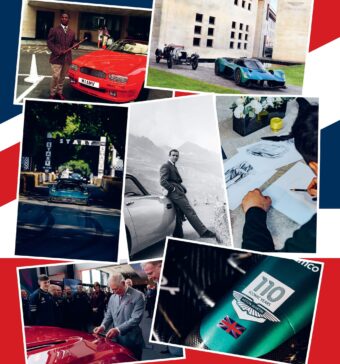
“From its association with the Royal Family to its enduring role alongside James Bond, and the broader influence of British creativity, from music to design, each chapter in the brand’s story contributes to a sense of authentic Britishness.”
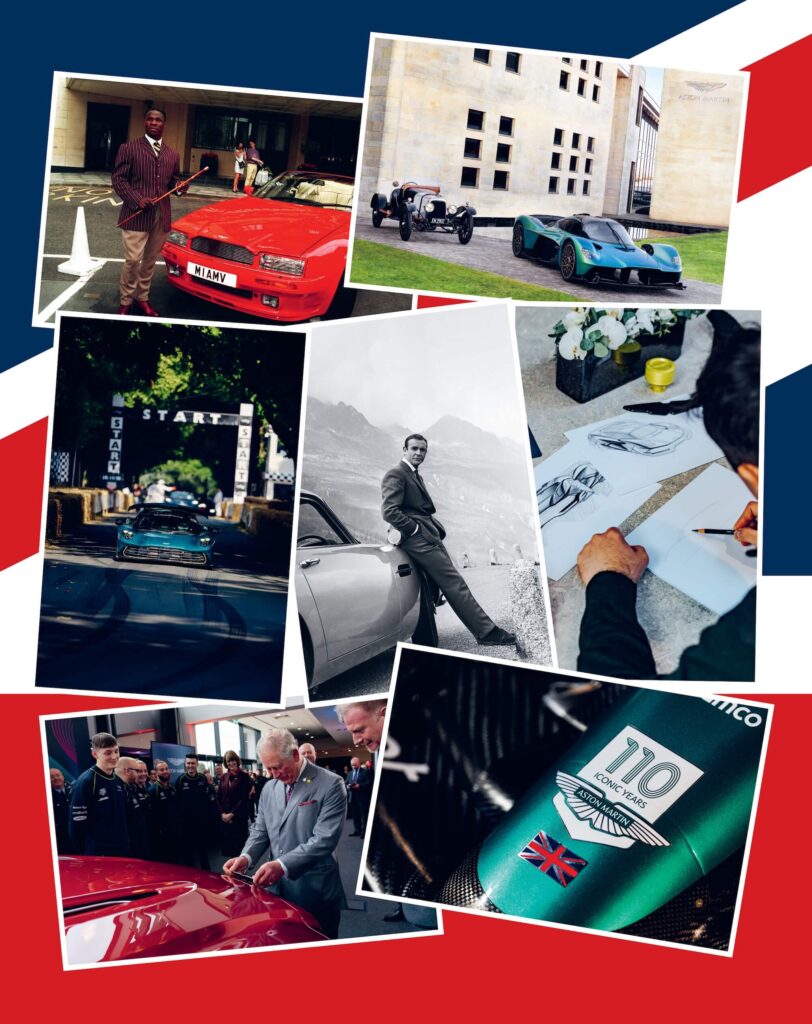
King Charles and 007: two lodestars in a landscape that could only be British. Each is innately stylish and operates with maximum integrity, underpinned with a certain wry appreciation for life’s twists and turns. Get into the warp and weft of the Britishness question, though, and some subtleties begin to emerge. As Marek Reichman, Aston Martin’s long-standing Chief Creative Officer, understands implicitly. It’s a subject he’s passionate about, but also articulates via the cars he and his team create.
“There’s a duality at work in Britain. As people, we are typically quite reserved and regimented,” he notes. “From the Industrial Revolution and the great British Empire to our renowned military, Britain has always been made up of systems that are very scientific and controlled.
“But there’s also a wild side to the UK. Look back on moments like the Beatles hitting the scene in the Sixties or the punk revolution a decade later… There’s a plethora of subversive and revolutionary movements in art and design, and I believe there’s always been an alter ego to the traditional rigour and sense of occasion that’s important to British identity. It’s this duality that highlights individuality, while also encouraging the culture of being a part of a collective.”
Reichman cites David Hockney, David Attenborough and Winston Churchill as inspirations. The latter is often held up as the embodiment of the ‘bulldog spirit’ and for his supremely statesmanlike qualities, but he’s keeping interesting company here. “Hockney had that spirit of revolution, and was an amazing artist who grasped the drama of change. David Attenborough’s willingness to carry on exploring and carry on giving is inspirational. He’s someone who has drilled down so much into his desires, who wants to figure out more about the world and explain it to us, to help us to keep it as perfect as it should be.”
There’s a popular theory that countries with more intemperate weather tend to generate a greater number of creatives – whether it’s designers, musicians or writers. If you’re staying indoors longer out of necessity, at least it’s an opportunity to master your craft. Reichman isn’t so sure.
“We’re a culture that allows you to fail, that allows you to experiment, and I think we can draw this back to the seasonality of Britain, not just our rainy days. The beauty of our country is that it is ever-changing. We have the geographical spread from the Outer Hebrides – mountains older than the Alps – all the way down to the hub of London, which is one of the most iconic and diverse centres on the planet. That’s what cultivates such creativity in this country: our seasonality, changeability, and diversity.”
The latter is an important factor for the Aston Martin Aramco Formula One™ Team Head of F1 Academy and Driver Ambassador, Jessica Hawkins. “The UK has always been a place where people, ideas and cultures come together,” she says, “and in motorsport that’s a huge strength. There’s a shared mindset of creativity, resilience and ambition. Being British is about a balance of heritage and evolution. There’s a respect for tradition, craftsmanship and history, but also a drive to innovate.”
Fellow racing driver, Darren Turner, highlights another significant British trait: understatement. “That’s important, but it’s coupled with a deep resilience and the desire to challenge ourselves to ever greater achievements through quiet determination.”
These are qualities that are evident in the people Turner nominates as personal inspirations: Lewis Hamilton, Barkley ultramarathon runner Jasmin Paris, and Aston Martin Aramco Principal Adrian Newey. “To have been part of the Aston Martin Valkyrie development team was hugely special, knowing that the original concept and design came from Adrian. The chance to help bring to life a car conceived by one of the greatest automotive designers of all time is something I will always be incredibly proud of.”
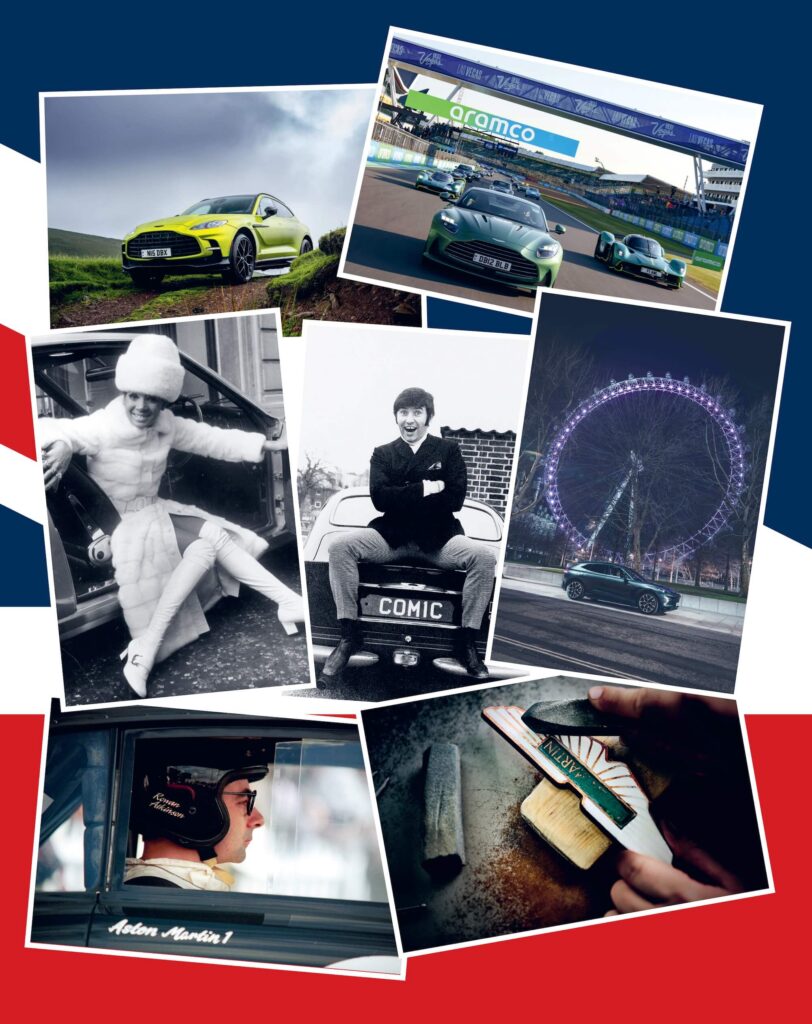
There’s also the question of how others see Britain, and how the country presents itself. A certain formality is part of the picture here, and that may play better beyond the British Isles than it does within. Reichman points to the differences between world-class automotive gatherings, notably Pebble Beach, the Villa d’Este concorso d’eleganza on the shore of Lake Como, and Britain’s very own Goodwood Festival of Speed, as illustration. There’s no more formal backdrop than a British stately home, but the Duke of Richmond – a man who understands the power of performance – willingly laces it with his own version of punk. “There’s an extremity that’s just outstanding,” Reichman suggests. “You’ll see a dragster going up the hill, or someone doing repeated doughnuts in a world of electrification. We see the influence of formality again in the honour of winning, a stature that is a product of the traditional and regimented nature of society, but Goodwood still holds a diversity and accessibility that’s brilliant. It’s high society, in an amazing old house, but it’s open to everyone to attend and enjoy.”
He also points to the roguish quality inherent in the Aston Martin DB5, one of the elements that presumably appealed to the producers of the James Bond film franchise back in the early Sixties (Albert R. ‘Cubby’ Broccoli and Harry Saltzman).
In addition to all of that, we must also mention the British sense of humour. Few countries’ citizens have such an abundant capacity to laugh at themselves, or at the frequent absurdities of life. “If you don’t take yourself too seriously, you can make light of occasions that would bring you down in many other societies,” Reichman insists. “The nature to say, ‘Let’s try again’ and ‘Let’s find the answer’ is why some of the most successful people on the planet did their best work in the UK. Einstein, for example, is not a Brit, but his studies and work in British education helped to define science. I believe it’s our humour that helps us to persist and succeed.”
Steve Waddingham, Aston Martin’s in-house historian, cites Queen Elizabeth II and Winston Churchill as inspirational British figures. But his third choice is rather less well-known and utterly compelling.
“Tony Mellor became an Aston Martin owner in the late 1930s, whilst serving in the British Army. What most didn’t know at the time was that Mellor was a real-life spy for military intelligence. Period documents prove that Aston Martin modified the car for him, working alongside him for several weeks at our factory in Middlesex. We fitted concealed compartments and special lighting to allow Mellor to carry out his clandestine activity.”
The car had a hard life, Waddingham says, becoming involved in high-speed journeys across Germany and into Holland. Miraculously, it survived World War II, as did its owner. Mellor managed to escape from the beaches of Dunkirk in an old canoe, paddling it halfway across the English Channel, until he came across a Royal Naval evacuation ship. It’s also said that Mellor was acquainted with a naval intelligence officer who was branching out into literary endeavours, a certain Ian Fleming.
Waddingham is another fervent advocate for the British sense of humour, and offers an historical Aston Martin slant. “Not only does the UK have a strong sense of humour – just look at the King’s White House speech this year for proof – but so does Aston Martin itself. Some of our previous owners or leaders had the best one-liners. When Victor Gauntlett was asked how many prototypes he built, “all of them” was his answer. Then there was the old tale of how David Brown sold a DB model to a friend at ‘cost’, only for the invoice to list it at £1,000 over the list price of the car…”
Finally, back to regional differences. Britain, long an international joke when it comes to food, has dramatically improved its standing of late. But there are still idiosyncracies, which brings me onto a vitally important question: could HP sauce work in Italy or the US?
Waddingham, an otherwise measured individual, is wholly unconvinced. “Short answer: no! Pass me the olive oil or the American mustard, please.”
Marek Reichman is even more dismissive. In fact, he may even be having a sense of humour failure. “I don’t like HP sauce. I’d never use it, and I don’t think Italy or America should either.”