Picture a British hero in your mind. What do you see? The motoring century has given us enough examples to hold our own interpretation – our own sense of what gallant endeavour should represent. Take the core components of heroism: bravery, sacrifice, determination, sporting achievement, persistence and resilience, loyalty and inspiration. You won’t have to look hard to find them all present within the pantheon of British champions woven through Aston Martin’s glorious history. Some are obvious, some are surprising – but all of them show exactly why Aston Martin goes motor racing.

JEAN SALMON (NEE BLOXAM)

From an early age, Jean Salmon was exposed to speed. Her mother, Ethel Liver, one of Britain’s first female driving license holders, would take Jean to watch the racing at Brooklands in the family 4.0-litre Lagonda, where legends like Tazio Nuvolari and Bernd Rosemeyer coloured her worldview. This inspired a trailblazing career.

Perhaps predestined to compete, she married not one, but two racing drivers. In 1955, her first husband, Roy Bloxam, entered her in a Ladies’ Race, her first, at Goodwood without her knowledge. Jean charged to third in her own Aston Martin DB2, against a field that included Pat Moss (Stirling’s sister). She went on to win her maiden race later the same year.

By 1957, Bloxam had caught the attention of Aston Martin technical director John Wyer, who instructed master engineer Jack Sopp to repair her broken DB2. Wyer later brokered the sale of David Brown’s own DB3 Coupé, in which Bloxam would hold the Goodwood closed car record for two years. A mark of her talent was that the works MGA team ran her in the fearsome 1957 Nürburgring 1000kms. That same year, she was awarded the Peter Bell Trophy for the most successful Aston Martin driver of the year… besting a list that included Moss, Carroll Shelby, Tony Brooks and Roy Salvadori!

ROY SALVADORI

A versatile, deceptively fast and hugely respected racer, Roy Salvadori was defined by his tough, but charming personality; traits that played into the stoic British ‘stiff upper lip’ post-war image of the 1950s and 60s. Though he never won a grand prix, despite 47 starts, he held the respect of other stars of the era, including Stirling Moss and Tony Brooks, for his light touch and renowned mechanical sympathy.

These traits shone through in sportscar racing, where speed must be blended with the ability to nurse a car through a storm. This was never more so than in the 1959 24 Hours of Le Mans, where Salvadori – the Essex-born son of Italian parents – became the only British driver to win the world’s most famous race outright for Aston Martin.

Paired with the American Carroll Shelby, who was suffering from dysentery, they staved off a determined charge from a mighty armada of Ferrari Testa Rossas. Staying true to team manager Reg Parnell’s slow and steady game plan, even as the red cars raced ahead in pursuit of Moss in the sister Aston Martin DBR1. Despite burning his feet on the pedals and pitting for a broken wheel, Salvadori calmly pressed on through the night. When dawn broke, the Ferraris and Moss’s Aston Martin had all failed, leaving Shelby to lead home Maurice Trintignant in another

DBR1 to a famous 1-2 victory. The unassuming Salvadori remained convinced that Moss should have won.

STIRLING MOSS

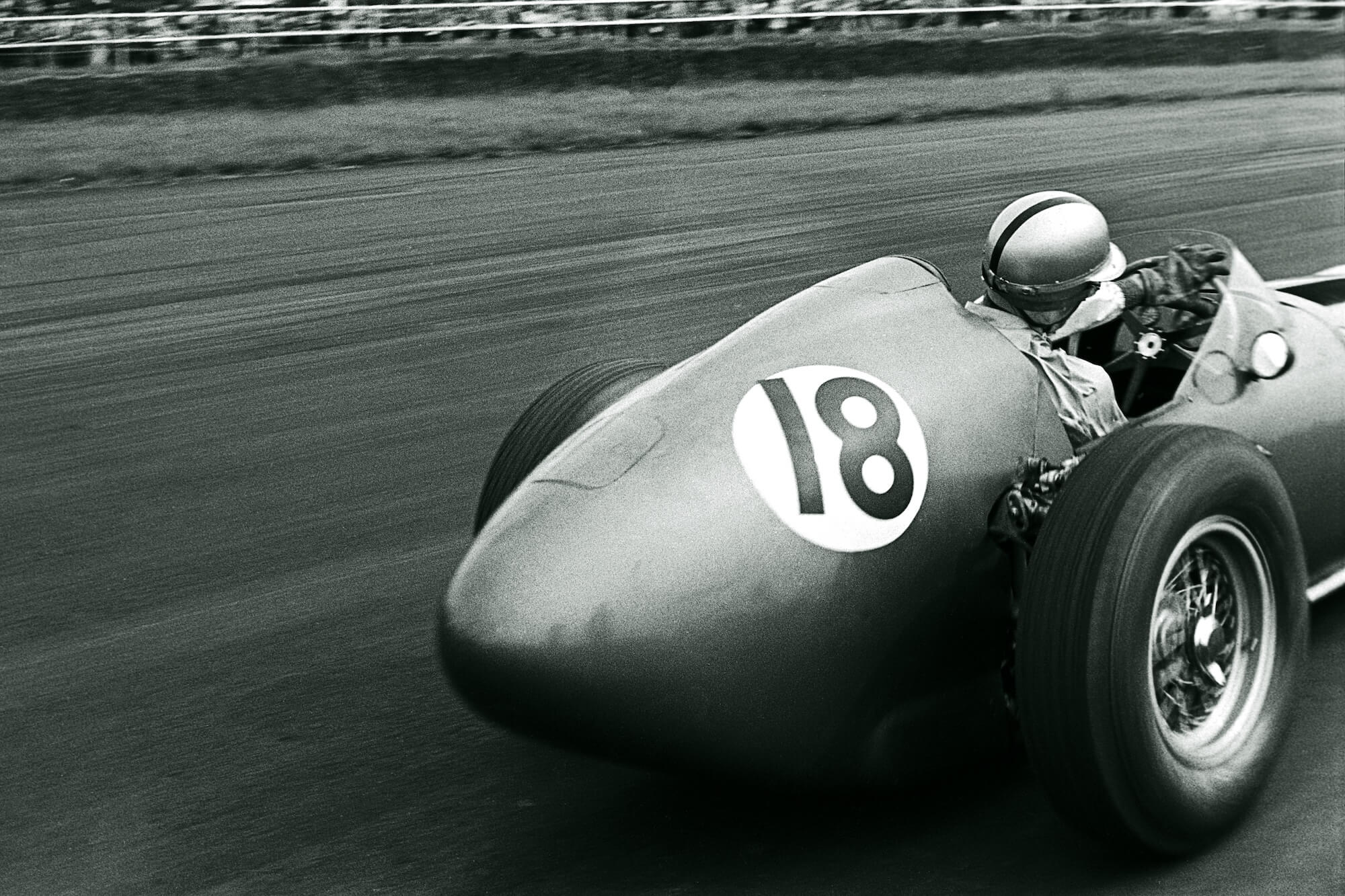
While Le Mans glory is often what people remember about Aston Martin in 1959, it was the talismanic presence of the mercurial Stirling Moss that shaped both that race and the ensuing five-round World Sportscar Championship (WSC) glory in a time when the Wings soared imperiously above their rivals.

It was Moss who convinced David Brown to greenlight a sole DBR1 be allowed to compete in the Nürbürgring 24 Hours, after Aston Martin had failed to finish in the Sebring 12 Hours and then didn’t enter the Targa Florio. It was also ‘The Boy’ who took the car to a five-minute lead before handing over to Jack Fairman. When a backmarker sent the car into a ditch, Moss had already changed into his civvies – only to discover that Fairman had physically manhandled it out of the undergrowth. Called back into action, Moss produced what he admitted was the ‘drive of my life’ to claw back the 75-second deficit to win.

When Aston Martin won Le Mans, it forced Brown’s hand, who entered three DBR1s for the finale at Goodwood. Moss led the early stages of that race, before teammate Salvadori was involved in a huge pit fire, destroying the team’s garages and badly damaging their DBR1. Moss was then drafted into Shelby and Fairman’s second-placed sister car. “I drove flat out for the rest of the afternoon,” and he raced past the leading Porsche to claim another extraordinary win. In those days, only manufacturers were awarded points in the WSC, and of course, Moss was never crowned world champion in Formula 1®… but for Aston Martin, in 1959, he was king of the world.

JIM CLARK

An iconic hero, Jim Clark is arguably the most gifted British racing driver of all time. He only won two Formula 1® World Championship titles, in 1963 and 1965, but one could argue that few were his equal on any grid until his death in 1968. Ruthlessly efficient and inch-perfect, Clark’s style oozed effortlessness. It played into the quiet, confident persona he carried wherever he went outside of the cockpit.

The Scot raced Jaguars for Jock McBain’s Border Reivers team in the 1950s and was famously synonymous with another British marque: Lotus. But that might have been different if David Brown’s works Aston Martin Formula 1® team had been successful. Team manager Reg Parnell presciently planned Clark’s grand prix debut in 1960. But when the debut of the DBR4 was delayed, Clark switched to Lotus and began a partnership with owner Colin Chapman, for whom he contested all 72 of his grands prix, winning 25 of them.

Clark did race an Aston Martin successfully – the ex-works DBR1 sportscar Border Reivers accepted in exchange for releasing Clark to race in F1 and rebuilt following a fire in the previous year’s TT at Goodwood. Teamed with Aston Martin’s only British outright 24 Hours of Le Mans winner, Roy Salvadori, the pair finished third in 1960, despite the car persistently throwing oil into the cockpit through a race blighted by rain. It was Clark’s only podium at Le Mans.

GRAHAM HILL

Of the 35 drivers who became F1 world champions, 11 of them were British. All of them are heroes. Graham Hill was the second champion from the UK, claiming the title in 1962, with BRM, the same year he raced the works Aston Martin DP212 at Le Mans, alongside his American F1 teammate Richie Ginther. The car, commissioned by the factory, was fast but delicate. Hill led the race initially and became embroiled in a fight with Ferrari for supremacy until the car ran into issues, ultimately retiring. Hill would claim another F1 title in 1968, with Lotus, leading the team after the death of his friend Clark.

The only man to win the Monaco Grand Prix, Le Mans and the Indianapolis 500, Hill had a famously rich and diverse racing career. Towards the end of it, his association with Aston Martin was rekindled through his own team’s sponsorship from the Imperial Tobacco Group’s Embassy brand. ITG had previously commissioned the Aston Martin ‘Sotheby Special’, designed by David Ogle. Based on the DBS V8 chassis, with fibreglass bodywork shaped around a tubular frame and featuring a fully glass roof, only three of the futuristic machines were built. One was painted in Embassy livery as a promotional tool and often appeared at circuits in 1973 promoting Hill’s fledgling F1 effort.

DARREN TURNER

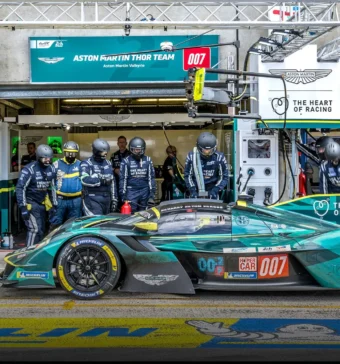
As British racing heroes go, few have enjoyed as long and successful a career as Darren Turner, Aston Martin’s longest-serving and most influential works driver. Still actively racing, having served the Wings faithfully for more than two decades, no one has raced (15) and won (3) more times in an Aston Martin at the 24 Hours of Le Mans.

Having played a key role in the brand’s return to the world’s most famous race with the glorious V12-powered DBR9 GT prototype, he achieved back-to-back class wins in 2007 and 2008 in a fierce battle with the Chevrolet Corvettes. That fight was rekindled ten years later, when he, Jonny Adam and Daniel Serra triumphed with a last-gasp class win against the American brand, again at Le Mans in 2017.

Endurance racing has evolved significantly since Turner first raced for Aston Martin in 2005, and yet there is not a car produced since, including the stunning Valkyrie Hypercar that contests the FIA World Endurance Championship and IMSA WeatherTech SportsCar Championship, that he wasn’t involved in developing.

It’s why Aston Martin calls on him to measure the performance and driving dynamics of all its prototype road car models to this very day.

FLICK HAIGH

Flick Haigh’s tale is simply extraordinary. To this day, she remains the only woman to have won the British GT Championship outright, in 2018, with four-time title holder Jonny Adam racing alongside in an Optimum Motorsport V12-powered Aston Martin Vantage GT3. Even in this enlightened era, she remains a strident, shining and brilliant outlier.

Adam describes the enigmatic Haigh as a hugely focused individual who would do anything it took to win. Shy out of the car, Haigh worked hard to win the loyalty of her team by leaving no stone unturned in her preparation. Having set her sights on the British GT Championship – following a successful equestrian career, then various smaller sportscar series – she learned every circuit in every condition, determined not to let her team down.

The preparation was worth it. Haigh became the first woman to claim an overall British GT pole position, at Oulton Park, before going on to record a brilliant debut win in the rain with Adam. Their campaign built momentum quickly, and another more dominant win followed at Brands Hatch, before they wrapped up the season and the title at Donington with fourth place. Then, as quickly as she appeared, she was gone from the series (give or take the odd one-off drive), having completed her quest.